|
Webring: What It Is, How It Works, and Why Fediring Is Bringing It Back to Life
From the '90s web to the social networks that track you: what a webring is, why Fediring makes sense today in the Fediverse, and how to join in five minutes.

Back then, browsing meant following links: one took you to another site, that site had a sidebar full of links, and an afternoon would disappear jumping between blogs, forums, and personal pages of people you’d never have found otherwise. There was no cynical timeline sorting results by god-knows-what parameters to decide who deserves to land in the top ten, and there was no algorithm deciding what you deserved to see, trained to keep you glued to the screen as long as possible.
Today most people don’t have a website. They have a profile. On Facebook, people squabble in the comments of memes shared without being read; on X, people insult each other in 280 characters — and some even pay for a subscription just to do it with a blue checkmark; on Instagram, meals and sunsets get documented for an audience that keeps scrolling without stopping. Big Tech has turned the internet into a standardized shopping mall where everyone has the same store with different signs.
The webring wasn’t born as a response to Big Tech: it predates them by a long shot. But today it’s being reborn as an alternative to their centralization, to discover sites that will never appear in Google’s top ten results and that don’t circulate on mainstream social networks. They exist, but without a mechanism like this you’d never find them — losing exactly what the original WWW was about: spontaneous discovery, wandering between links.
Table of contents
What a Webring Was
In the footer or sidebar of almost every ’90s website there was a row of 88×31 images: tiny badges declaring affiliations, preferences, allegiances. “Made with Notepad”, “Netscape Now”, and in the middle of it all, the badge of whatever webring you belonged to, with two arrows: one to go forward around the ring, one to go back.
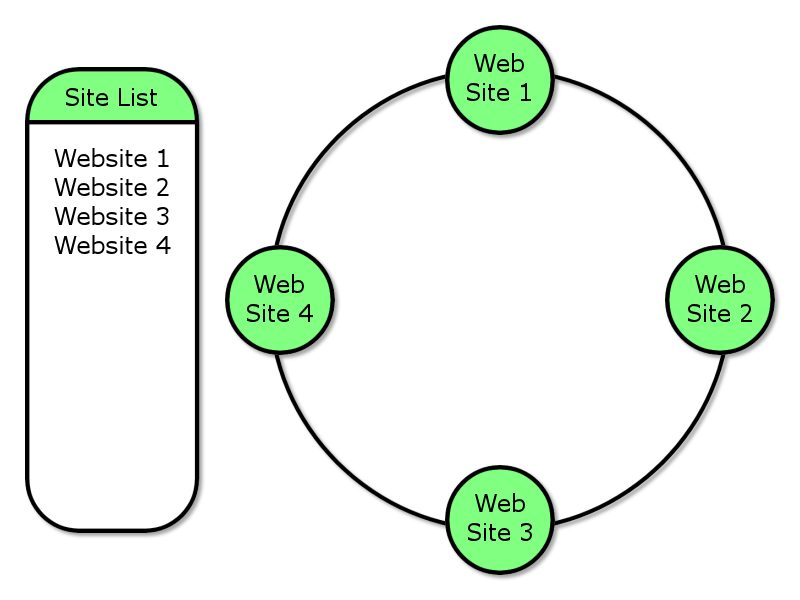
The mechanism was simple: a group of sites sharing a common theme linked to each other. Each site included three links: previous site, ring’s central page, next site. Whoever clicked the forward arrow landed on the site of whoever had joined after you. Nobody knew in advance where they’d end up.
The code was simple: no cookies, no tracking, no algorithmic rotation. It worked differently from banner exchanges, which counted impressions and automatically balanced swaps — that was already closer to advertising. Webring badges were static, declarative. A kind of “I’m part of this circuit” displayed in plain sight.
Why It Almost Disappeared
At some point we stopped clicking those links because it was faster to open Google and search directly for what you wanted. And Google was good, very good. Webrings were for discovering new sites, and Google did that better, faster, without having to follow a ring one site at a time.
Then social networks arrived. And it wasn’t that webrings became less useful: it’s that the very reason for their existence disappeared. Opening a Facebook page was simpler than buying a domain, setting up hosting, learning basic HTML. People stopped making sites and started making profiles. And when the site disappears, so does the need to connect it to others.
The Return: Fediring and the Fediverse
On the Fediverse it still happens fairly often that you stumble onto someone’s personal website. You spot it linked in a Mastodon bio, click through, and find a blog with real articles written by a real person. Not content optimized for reach, not threads engineered to generate reactions: a website, with a person behind it.
Fediring was born in exactly this context. To join, you need two things: a website reachable via HTTPS and an active account on the Fediverse. Not an Instagram profile, not a LinkedIn page, but an account on a federated platform — which already filters for people who have made a deliberate choice about how to be online.
The member list is public, maintained by hand by the ringmaster. There’s no algorithm deciding who gets more exposure. No impressions, no engagement scores. Just a list of names and URLs, navigable one site at a time, like thirty years ago.
How It Works in Practice
You add three links to your site’s footer, with your domain in the URL:
<a href="https://fediring.net/previous?host=yourdomain.com">←</a>
<a href="https://fediring.net/">Fediring</a>
<a href="https://fediring.net/next?host=yourdomain.com">→</a>
Then you send an email — strictly in plain text — with your site’s URL and your Fedi handle. A public ticket opens on Sourcehut, the maintainers review it and add you. No reCAPTCHA form, no “continue with Google”. You can find everything at fediring.net.
When someone clicks the arrow, Fediring’s server reads your domain, finds your position in the list, and redirects to the next site, automatically skipping any that are unreachable. No scripts loaded on your page, no requests to third-party servers, no JavaScript. Two links and a server-side redirect. That’s it. And it’s precisely this simplicity that makes it reliable.
Why I Joined
This isn’t nostalgia. Nostalgia is thinking everything was better before just because it was before.
I built Homelab Notes from scratch to have a space of my own to write and stop depending on mainstream social networks. Almost all the plugins running on this blog I wrote myself. That meant dusting off programming skills I hadn’t used in a while, but above all writing a lot more.
I joined because I want to know what the people who chose to have a website in 2026 are building — when opening a profile is so much easier. Whoever ends up in Fediring sent an email, added three links to the footer, waited for approval. They did something concrete, they didn’t just click “sign up”.
On social networks you see what the algorithm has decided you should see. On Fediring you see the site of whoever joined after you. Nobody decided that site deserved more visibility than another: it’s there because someone decided to be there.
Fediverse Reactions

My name is Emanuele Gori and in my spare time I write about open source software, digital privacy and self-hosting.
Homelab Notes was born from my belief that technology should serve the people who use it, not the ones who sell it. Here you'll find practical guides and analyses to help you reclaim control of your digital life, one service at a time.
This blog is customized with a few WordPress plugins I built to improve its usability and sharing: open source and freely downloadable from git.emanuelegori.uno.
If you'd rather follow part of my digital life, visit the Activity Hub page.
On the Fediverse as in life: no algorithms in between!